Dirt Work

How to Prepare Your Lot for a House Pad in Southwest Louisiana

Lucas LaCour6 min read

Wet ground, heavy clay and hurricane season make pad work in Calcasieu Parish its own animal. Here is how we approach a build pad so the slab that lands on it stays put.

Everything you build sits on the dirt underneath it. In Southwest Louisiana that dirt is usually heavy clay that holds water, swells when it is wet and shrinks when it dries out. A pad that was not built right will tell on itself in the first year — hairline cracks in the slab, doors that stop latching, water standing where it should not.

Here is the order we work in on a residential build pad, and what we are looking for at each step.

1. Walk the lot before anything moves

Before a machine ever rolls off the trailer we want to know where the water goes. Stand on the property after a hard rain if you can. Note the low corners, the ditch line, the road elevation, and where the neighbors drain. Your pad has to sit high enough to shed water without pushing that water onto somebody else — that is a conversation worth having up front, not after the dirt is spread.

2. Strip the topsoil and organics

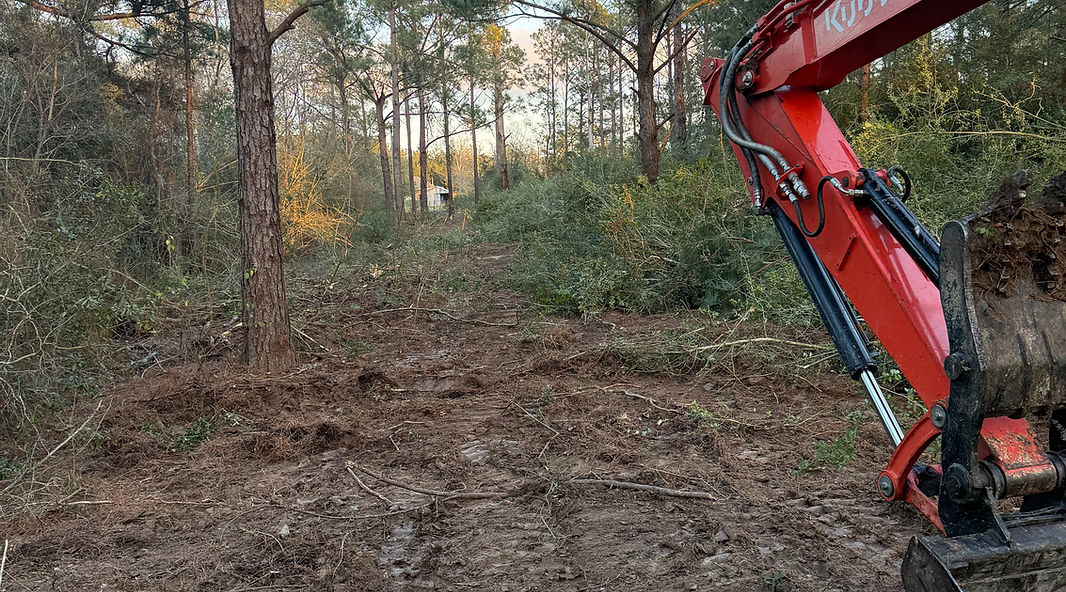
Topsoil is great for a garden and terrible under a slab. It is full of roots and organic material that will keep decomposing and settling for years. We strip it off the pad footprint and stockpile it — it gets reused for finish grading and yard work once the structure is up. Stumps, root balls and any buried debris come out at this stage too.

3. Build the pad in lifts and compact each one

This is the step people try to skip and it is the one that matters most. Fill dirt goes down in lifts — think 6 to 8 inches at a time — and each lift gets compacted before the next one goes on top. Dumping three feet of dirt and rolling the top of it gives you a firm crust over soft fill. That pad will settle.

Moisture content matters just as much as the roller. Clay that is too wet will pump and rut instead of compacting. Clay that is bone dry will not bind. Part of the job is knowing when to work it and when to let it dry a day.

4. Set your elevation with a laser, not an eyeball

We shoot grade with laser and GPS equipment on every pad. You want the finished pad high enough above the surrounding grade that water runs away from the structure on all four sides, with the fall carried out to a ditch, swale or culvert. An inch of slope in the wrong direction is an inch of water against your foundation for the life of the building.

  • Pad crown set above the surrounding natural grade so water sheds away
  • Positive fall carried away from all four sides of the structure
  • Driveway and culvert tied into the same drainage plan, not treated as an afterthought
  • Silt fence or erosion control in place before the first rain

5. Let it sit if the schedule allows

A pad that gets a few weeks and a couple of good rains before the slab is poured tells you a lot. If it is going to settle unevenly, you would much rather find that out with a machine still on site than after the concrete truck leaves.

A good pad is invisible. Nobody compliments you on it — they just never have a problem.

Before you break ground

Check with your parish or city permit office on what is required for your specific lot, and call 811 to have utilities located before any digging starts. Requirements vary by jurisdiction and by whether you are in a flood zone, so get that answer in writing before dirt moves.

If you have a lot in the Lake Charles area and you are not sure what it needs, call or text us at 318-452-7653. We will come look at it and tell you straight.

Keep Reading

Red iron steel building frame going up on a job site
Steel Buildings

Steel Building vs. Stick-Built: How to Decide

Shops, barndominiums, warehouses and retail — steel is not automatically the answer, but for a lot of Louisiana projects it is. Here is the honest comparison.

Have Questions?   Call or text  318-452-7653

Click to Inquire Now