Land Clearing — Lake Charles, LA
Land Clearing and Forestry Mulching in Lake Charles and Calcasieu Parish
Land clearing is our favorite service to provide and we are equipped to clear any size property, from a single overgrown town lot to a hundred-acre pasture conversion. References available on request.
Three different jobs people all call "land clearing"
Almost everybody who calls us about land clearing services means one of three different jobs, and it helps to know which one you actually want before anything gets priced — they cost different amounts and they leave your property in very different conditions.
Forestry mulching grinds standing brush, saplings and small trees in place and leaves the material on the ground as a mulch layer. Nothing is hauled off, the root mat stays intact, and the ground stays stable and walkable. It is the fastest and usually the cheapest option, it is the right answer for reclaiming overgrown ground or opening up sight lines, and it is the wrong answer if something is going to be built there.
Full clearing and grubbing takes the vegetation out root and all, so the ground is ready to be shaped and built on. It is more machine time, it produces material that has to be dealt with, and it leaves bare dirt that will need seeding or a pad. Stump grinding sits in between: the trees are already gone and what is left are the stumps, ground down below grade so they are not in the way of a mower or a slab.
Tell us what the land is going to be used for and we will tell you which one of the three you need. Paying for grubbing when mulching would have done the job is a common way to overspend on this work.
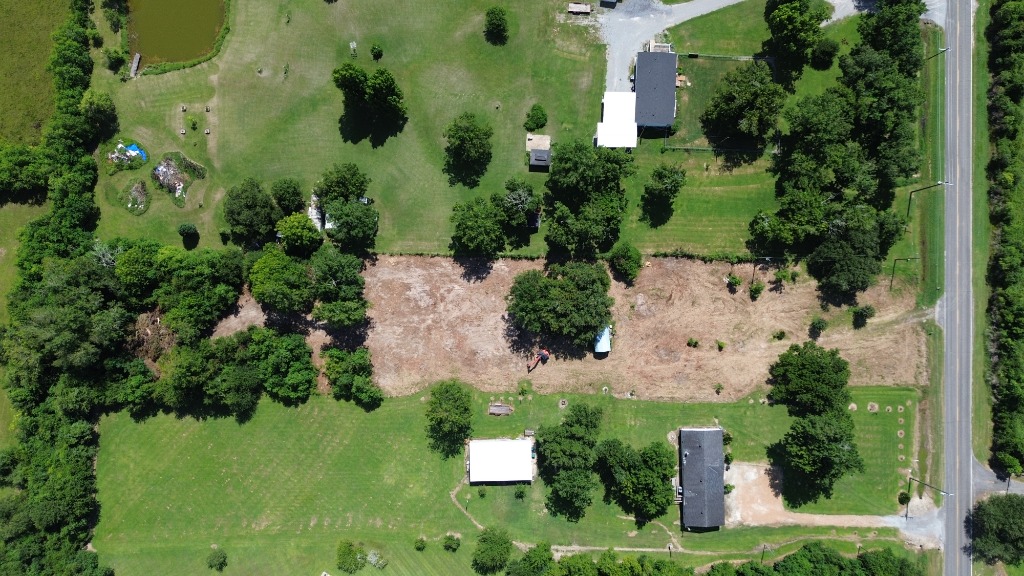
Equipment sized to the job, not to the invoice
We run everything from trench burners to specialized excavators, plus dozers, track loaders and tractors. That range is the point: a machine too big for a town lot does damage getting in, and a machine too small for forty acres turns a week into a month, and you pay for the difference either way.
It will never be our decision to sacrifice the quality of the work on your property to save ourselves time. Efficiency adds value when it comes from having the right iron on site, not from cutting the job short.
What is worth deciding before the first machine arrives
These are the questions that change the price or the outcome, and the ones people most often have not thought about. None of them need an expert answer from you — we just need to talk through them.
- What the ground is going to be used for afterwards: pasture, a homesite, a shop pad, food plot, or just not being a thicket any more
- Which trees stay. Mark them, or walk the property with us and we will flag them together. This is the single most common regret on a clearing job
- Where the property lines actually run. If the corners are not findable, a survey is cheaper than clearing your neighbor's brush
- Whether the material can stay on site as mulch, be burned where that is permitted, or has to be hauled off
- Where utilities, septic fields, water lines and pipelines cross the tract
- Whether any of the ground is wet enough often enough that clearing it raises questions you should ask before, not after
Wetlands, burn permits and the things we will not guess at
Parts of Southwest Louisiana hold water, and some low ground is subject to federal wetland rules that have nothing to do with whether it looks wet the day you stand on it. Clearing regulated wetland without a permit is the property owner's problem, not the contractor's, and it is an expensive one. If a tract has low ground we will say so and point you at the right people to confirm it before we start, because that determination is not ours to make.
The same goes for burning. Whether you can burn cleared material, and under what conditions, depends on where the property is and on current state and local rules. We are not going to tell you it is fine on a page that might be read a year from now. Ask us during scoping and we will tell you what the situation is at the time.
This is a slower answer than "we will take care of it," and it is the honest one. The alternative is a contractor who tells you what you want to hear and leaves you holding the consequence.
How a clearing job runs
You call or text with the acreage and the address
Rough acreage and a location is enough to start. A pin drop or a parcel number is better, because we can look at aerial imagery before we drive out.
We walk the property with you
This is where the keep-and-cut decisions get made, the access route gets picked, and the wet ground and the property corners get looked at.
We scope it as mulching, grubbing or stump work
You get told which one, why, what it includes, and what happens to the material. If two approaches are both defensible we will price both and let you choose.
We schedule around the ground condition
Clearing heavy ground when it is saturated does damage that costs more to repair than the wait cost. Where the schedule allows, we work with the weather rather than against it.
We clear it and walk it with you
Before we call it done, you walk it. Anything that got missed gets handled while the equipment is still on site, which is much cheaper than a return trip.
Questions we get about land clearing
- How much does land clearing cost per acre?
- There is no honest per-acre number that covers both a pine thicket full of saplings and a tract with mature hardwood and standing water. What drives the price is stem density, the size of the biggest material, how wet the ground is, how far the access is, and whether the material stays or goes. Give us the address and the acreage and we will come look, then you get a real number.
- What is the difference between forestry mulching and clearing?
- Mulching grinds vegetation in place and leaves it on the ground as mulch, with the root mat intact and the surface stable. Clearing and grubbing removes the vegetation root and all and leaves bare dirt ready to be shaped. Mulching is faster and cheaper and better for reclaiming ground; grubbing is what you need before you build.
- Can you clear a small city lot, or do you only take acreage?
- We clear town lots. It is a different machine and a different plan — access is the constraint, not horsepower — but it is work we do. Overgrown lots inside Lake Charles and Sulphur come up regularly.
- Do I have to haul the debris off?
- That is decided in the scope and priced up front. Depending on the property and what is currently allowed, material can be mulched in place, windrowed, burned where that is permitted, or hauled off. Hauling is the most expensive of those, which is why it is worth a conversation rather than an assumption.
- Will clearing make my property flood, or flood my neighbor?
- It can change how water moves, and that is a fair thing to ask about before you start. Removing vegetation and disturbing the surface changes runoff, and on flat ground small changes matter. We will talk through it when we walk the property and tell you if what you are asking for looks like it needs a drainage plan alongside the clearing.
- How long does clearing take?
- A town lot is often a day. A few acres of light brush can be a couple of days. Forty acres of dense material with wet ground is measured in weeks and moves with the weather. You will get a real window at scoping, and a call when the weather changes it.
- Do you clear land you are not doing the rest of the work on?
- Yes. Plenty of clearing jobs are just clearing. If the next step is a pad or a building, we can do that too, but nothing about the clearing price depends on it.
Clearing by area
Most of our clearing work happens in these communities. Each page covers the kind of ground and the jobs that come up there:
Send us the address and the acreage
Call or text 318-452-7653 with a location and a rough size and we will look at the aerial before we drive out. Then we walk it with you and tell you which of the three jobs you actually need.